Back
|
Back
|
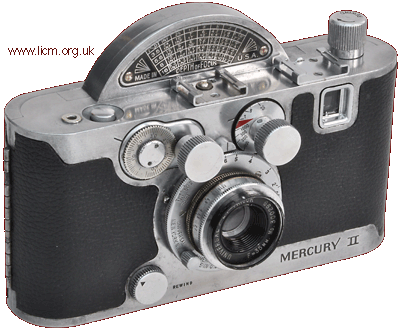
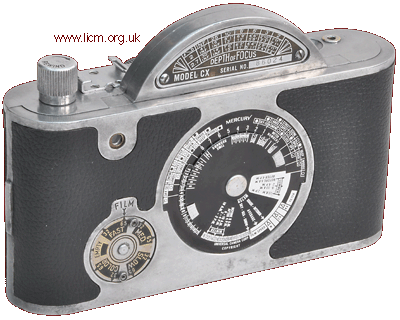
| Universal, Mercury II, Model CX half frame 35mm camera, c1945 |
|
The Mercury II is a distinctive and attractive camera made in USA for 35mm (135) film in half frame format, this model CX being the most commonly found. The image area being 19x25.5mm portrait orientation. The principle advantage being an impressive 65 images out of a roll usually expected to give 36 exposures. Despite the smaller negative area the resulting camera wasn't any smaller or lighter than many contemporary competitors. To put it into context it's 57gms (2oz) heavier than a Leica III of the same era, with neither rangefinder, slow speeds or resolution of that camera, or the price tag in fairness. The camera was of cast aluminium alloy and not finished in any way, the castings are crisp without any machining required aside from a few threads and holes to cut. When new they were polished to a high standard and would hold a good shine. Eighty years on the shine has dulled somewhat as the alloy has tainted, I suspect there's a degree of zinc in the alloy to improve the casting flow characteristics. As a result they often turn up fairly badly pitted and corroded, but if looked after they retain a decent cosmetic shine. The two castings are hinged together to form the back and front of the camera and close with a beautifully tight and accurate closure line, held shut by a precise little clasp, released by a button on the base. The camera exudes a bit of class not exhibited by many American cameras, this being enhanced by the distinctive curved top required to house the rotary sector shutter, an odd but delightful choice largely responsible for the camera's dimensions and heft. The black in fill material is a plasticized faux leather, a decent choice in the day, sadly subject to aging. The shutter is essentially two discs with a sector removed from each, rotating one in relation to the other alters the sector angle sweeping the film plane and hence the shutter speed. The discs are locked together by the shutter speed selector mechanism, so there is no danger of "capping", where one disc catches up with the other. The downside is that the shutter selector mechanism also needs to rotate so the mass of rotating assembles carry a fair bit of inertia that needs to be arrested at the end of the exposure, this results in a bit of a jolt. The mechanism, when in good form, is deliciously smooth aside from the small jolt as the rotating shutter is brought to a halt. The two prominent knobs on the front are the shutter speed selector on the right and the film advance/cocking mechanism on the left. When making an exposure the photographer would need to keep their fingers clear of the shutter selector as it needs to spin unrestricted. Focus is set using a rotating milled disc surrounding the lens, a small post grip added to make this easier, although the engravings aren't the clearest. The aperture setting engravings are positively miniscule though, these being set via a ring around the lens barrel. The collection acquired this Mercury II from a California yard sale during November 2000, in deteriorating but generally sound condition. Cleaned and serviced at the time after 25 years in the cabinet it came around for another service in September 2025. This came about as the camera was looking decidedly tatty, the faux leather had become stiff and curled away from the body, the aperture stiff, focus hard to move, viewfinder dull and shutter sluggish. It's now much happier. The images show it after cleaning, still showing some evidence of dulling of the finish. Once they deteriorate to any significant degree it's hard to polish out without removing a fair amount of material as the castings have a degree of porosity enabling the dulling to penetrate. The CX was itself a development of an earlier camera dating from 1938, the model CC. These are rarer than post war models and also harder to use if you find one as as they had yet to adopt the Kodak 135 cassette so require specific spools, often missing. As an aside, motion cameras for which 35mm was originated used the film in this size, running vertically in landscape format. It was the use of the film in still cameras that lead to running the film horizontally to produce a larger negative, or what we would generally accept as "full frame". |
|
|
| Body No. 86024 Shutter, sector shutter - focal plane, T, B, 20, 30, 40, 60, 100, 200, 200 & 1000th sec. Lens, Universal Tricor, 35mm 1:2.7, serial 300299 |
 |
|

|

|

|

|
 |
© Living Image Vintage Camera Museum 2000-2026